
Projected vs Actual Release Date
A projected release date is a calculation or schedule. An actual release date is the custody event after it happens. In Clear Creek County, those two ideas are easy to confuse because the local jail does not publish a confirmed county-hosted 24-hour or 72-hour release feed. For a person in Clear Creek County Jail, the release date may be created by bond processing, court order, time served, completion of a local sentence, MITT or work-release status, dismissal, transfer to CDOC, transfer to another agency, or a hold/detainer. For a state-prison inmate, CDOC may show parole eligibility, a next parole hearing, an estimated mandatory release date, or later discharge information.
Scheduled vs actual: a scheduled or estimated date can move. A VINE alert, CDOC field, bond estimate, or parole calendar entry should be treated as a lead until the jail, CDOC, court, or receiving agency confirms the final release date/time and release reason.
Pretrial detainees usually do not have a fixed release date. Their release may depend on bond conditions, a court order, dismissed charges, a hold, or paperwork reaching the jail. Clear Creek's Bonds page gives the strongest local timing rule: after required bond funds and documents are complete, the Sheriff's Office must process release within the six-hour rule in C.R.S. 16-4-102, subject to statutory exceptions such as electronic monitoring circumstances.
That local timing rule should not be converted into a guaranteed pickup time. The county source ties the clock to completed funds and documents, while the final release can still be affected by identity paperwork, signed bond documents, monitoring setup, another warrant, or a transfer order.
How to Find a Clear Creek County Inmate's Release Date Lookup
Start with custody type, then use the matching system. CDOC is not the first stop for a person who simply bonded out of Clear Creek County Jail. The Sheriff's Office and court records are not the correct place to calculate a Colorado prisoner's mandatory release date. Use the steps below to keep the systems separate.
- Decide whether the event is a Clear Creek County Jail release, a CDOC state-prison release, a federal BOP release, an ICE transfer/release, or a transfer to another county or agency.
- For a local jail release, check Clear Creek County's Inmate Custody Status page and Colorado VINE first if the event is current or recent.
- If bond is involved, review the Clear Creek County Bonds page. It explains that the jail accepts bonds at all times and that the six-hour processing period begins after required funds and documents are received.
- Search the Colorado Judicial Branch docket search or CoCourts for the Clear Creek case. Court records can explain bond, disposition, sentence, probation, future hearings, or closed status.
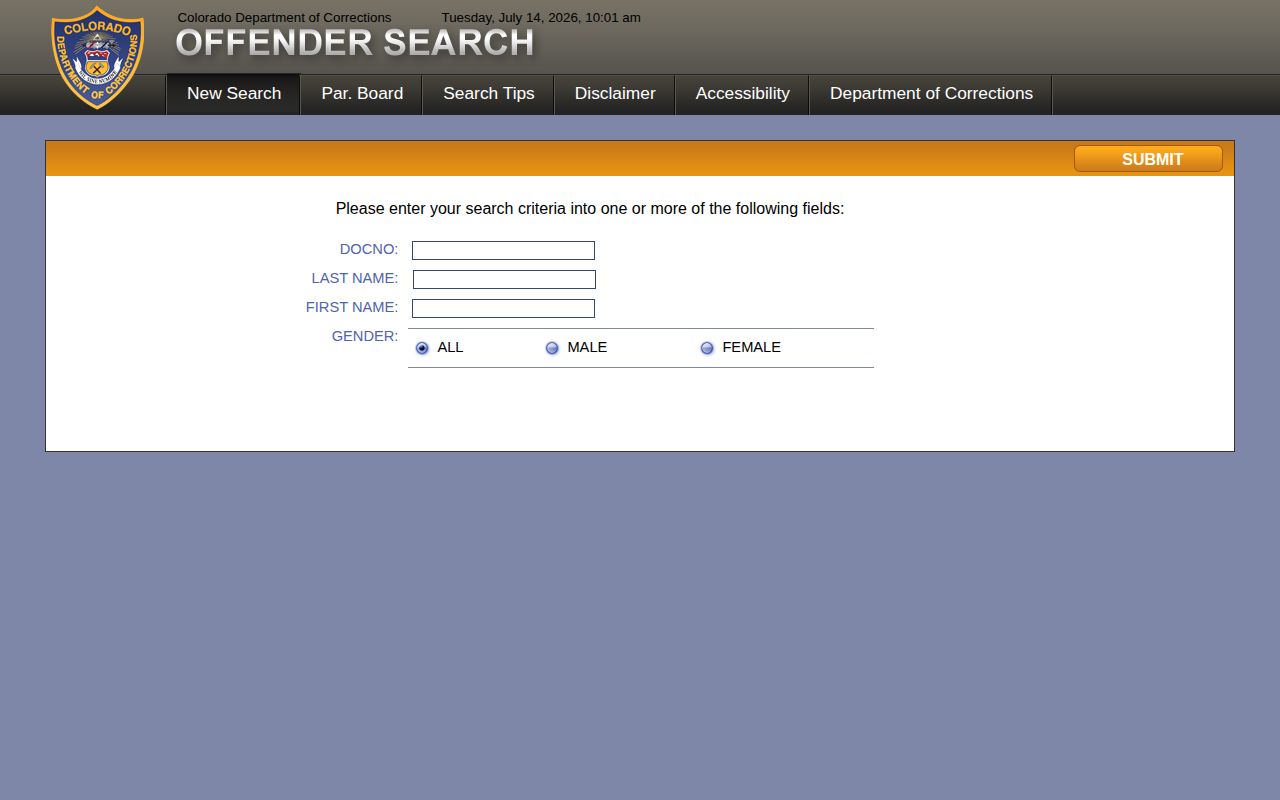
- If the person was sentenced to CDOC or transferred from the jail to state custody, search the CDOC Offender Search. Use DOC number when available; otherwise search by name and gender, with attention to arrest or prosecuted names.
- Read CDOC dates by label. "Estimated Parole Eligibility Date" is not a guaranteed release. "Next Parole Hearing Date" is a hearing schedule. "Estimated Mandatory Release Date" is closer to a release calculation, but still needs confirmation.
- Register for VINE notifications when a release or transfer may be pending, then confirm the final date through the Sheriff's Records Unit, CDOC, court records, BOP, ICE, or the receiving agency as appropriate.
For a broader local release-record field list, use the Clear Creek County released inmates home page and ask for the specific release date/time, release type, bond or sentence status, and transfer or hold information if releasable.
Source: CDOC Offender Search.
Good-Time Credit and How Release Dates Are Computed
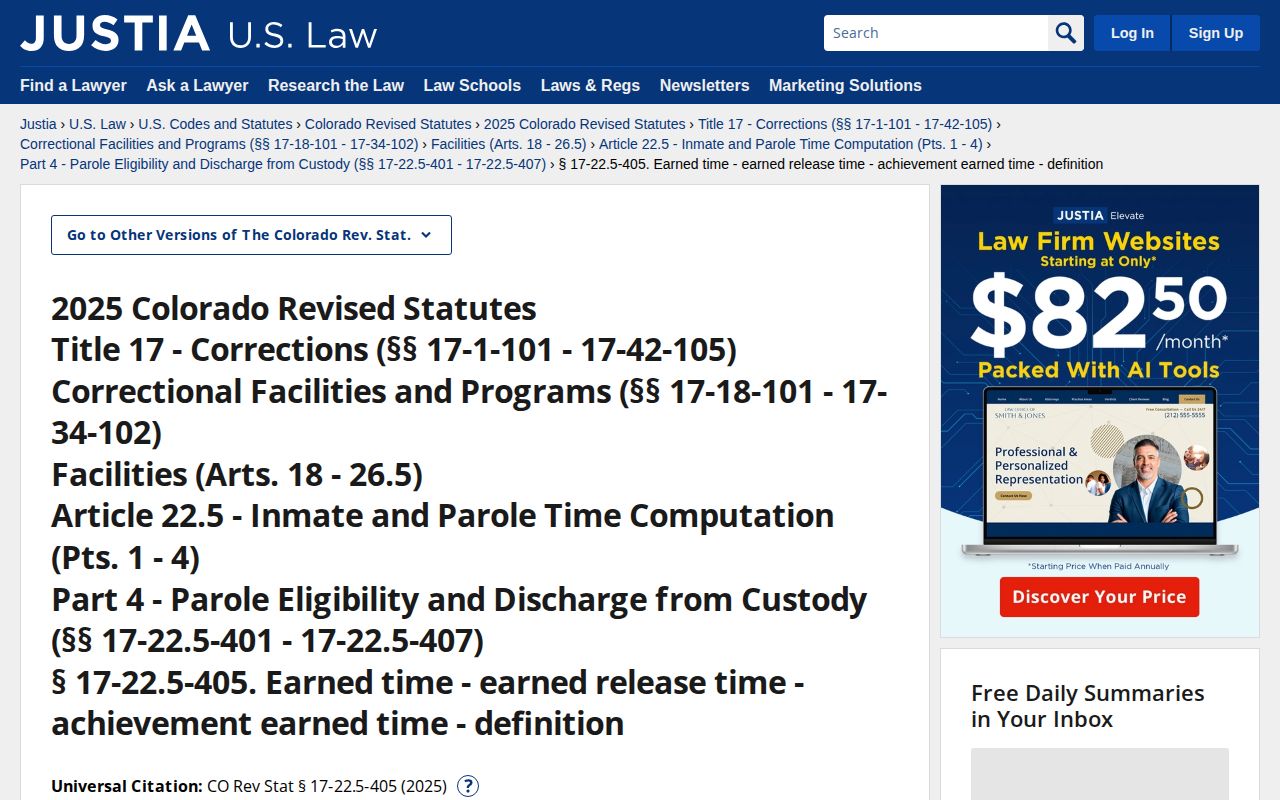
Colorado prison release dates are sentence calculations, not county jail guesses. CDOC dates can be affected by parole eligibility, earned time, mandatory release rules, disciplinary extensions, sentence structure, and offense-date law. C.R.S. 17-22.5-403 governs parole eligibility for covered offenders and allows parole eligibility dates to be extended for misconduct under CDOC rules. C.R.S. 17-22.5-405 authorizes earned time for eligible inmates and parolees, including up to ten days per month under the general provision and up to twelve days per month for certain lower-level felony or drug-felony sentences when statutory progress criteria are met. C.R.S. 17-22.5-302 can matter for older sentence structures.
Violent-offense rules are more restrictive. HB24-1127 describes Colorado's 75% parole-eligibility framework for certain violent offenses and related changes. Proposition 128 increased the requirement to 85% before parole eligibility for covered violent crimes committed on or after January 1, 2025, and prevents earned time from reducing that 85% requirement for those covered crimes. A public page should not try to calculate a person's date from those statutes alone, because offense date, conviction type, sentence language, presentence credit, and CDOC administration all matter.
Clear Creek County Jail release timing is different. Bond release is governed locally by the completed bond process and C.R.S. 16-4-102. Sentenced local time, MITT, and work release depend on the court order and jail computation. CDOC's prison date fields do not calculate a short local jail stay unless the person has entered CDOC custody.
For Clear Creek local sentenced time, the court's mittimus or sentencing paperwork is the starting record and the jail's calculation is the custody record. The county MITT page supports that distinction because it treats the court-supplied MITT as part of sentenced-time processing, while the jail handles local intake and release logistics. Work release is similar: the court may grant the privilege, but the jail determines participation. Neither local process creates a CDOC projected release date unless the sentence later places the person in state-prison custody.
Source: C.R.S. 17-22.5-405 earned time.
Release Date Terms Compared
Use the exact term from the source record. A "release date" in BOP can mean something different from a Clear Creek jail release time, and a CDOC parole eligibility date is not the same as sentence discharge.
| Date or term | System | What it means |
|---|---|---|
| Bond release time | Clear Creek County Jail | Local release processing after required bond funds and documents are complete; the six-hour rule applies unless statutory exceptions apply. |
| County release date/time | Sheriff / jail record | Date and time the person left Clear Creek custody by bond, time served, court order, transfer, sentence completion, or another release reason. |
| Parole eligibility date | CDOC | First possible state-prison parole consideration date under sentence law. It is not guaranteed release. |
| Next parole hearing date | CDOC / Colorado State Board of Parole | Scheduled public parole-board event. Hearings can change and do not prove release happened. |
| Estimated mandatory release date | CDOC | Estimated date release becomes mandatory under sentence and credit rules, still subject to verification. |
| BOP release date | Federal Bureau of Prisons | A future date is projected; a past date with no facility generally means release from BOP custody, not necessarily release from every justice system. |
Why a Release Date Lookup Changes
Release dates change because the record is a live legal and custody calculation. A bond estimate can move when documents are missing. A jail release can turn into a transfer. A parole hearing can be reset. A CDOC date can move because earned time was added, withheld, withdrawn, or restored. Treat each change as a reason to verify with the agency that owns the record.
| Change factor | How it can affect the date |
|---|---|
| Incomplete bond funds or documents | The local six-hour bond-release period begins only after the jail receives required funds and documents. |
| Electronic monitoring or statutory exception | C.R.S. 16-4-102 allows longer handling in described circumstances; ask the jail what condition applies. |
| Presentence confinement credit | Credit can change how a sentence is applied and whether time served satisfies a local or state sentence. |
| Amended mittimus or corrected sentence | A corrected court order can change the calculation used by the jail or CDOC. |
| Consecutive or concurrent sentences | Sentence structure changes whether terms run together or one after another. |
| Earned time or disciplinary misconduct | Earned time can move eligibility earlier; misconduct can delay or reduce credit under CDOC rules. |
| Parole decision | A grant, deferral, rescission, revocation, or continued hearing changes the practical release path. |
| New warrant, hold, or detainer | A person may leave Clear Creek custody but be transferred to another agency instead of released to the community. |
| Data lag or public-system error | CDOC warns that public database information may be inaccurate and should be confirmed with CDOC. |
Confirming a Release Date
Use VINE for custody changes and release notifications, then confirm the exact release date through the source agency. Clear Creek County's official Inmate Custody Status page routes users to Colorado VINE and lists the Colorado VINE phone number, 888-263-8463. VINE can alert you to a release, transfer, or custody-status change, but it is not a permanent release archive and may not preserve every old county jail event in a useful public view.
For a local release, request the booking/release record from the Clear Creek County Sheriff's Records Unit and ask specifically for the release date/time, release type or reason, charges or case number, bond or sentence status, and transfer or hold information if releasable. For a state-prison date, confirm with CDOC because the public search disclaimer warns that information may contain errors. For a court-driven release, use the Clear Creek court docket or Register of Action to verify the order that caused the release. For federal or immigration custody, use BOP or ICE rather than a county jail page.
To set the alert before the event happens, use the VINE Inmate Check page and register on the matching offender record with a phone, email, text, or TTY option where offered. If VINE has no result, do not assume there was no release. Use sheriff records and court records to close the gap.
When the date is being checked after the fact, keep the agency order straight. A Clear Creek jail release record can show the person left local custody, but it may also show transfer to CDOC, another county, BOP, ICE, or another authority. A court docket can show why jail custody ended, such as bond, sentence, dismissal, probation, or a later hearing. CDOC can show state-prison release and parole information when the person is in that system. BOP and ICE searches apply only when the person is in those separate federal or immigration systems.
If the public result and the agency record disagree, rely on the originating agency's correction or confirmation. Public search screens are useful starting points, but the release record, court order, or CDOC confirmation is the stronger source for final timing.